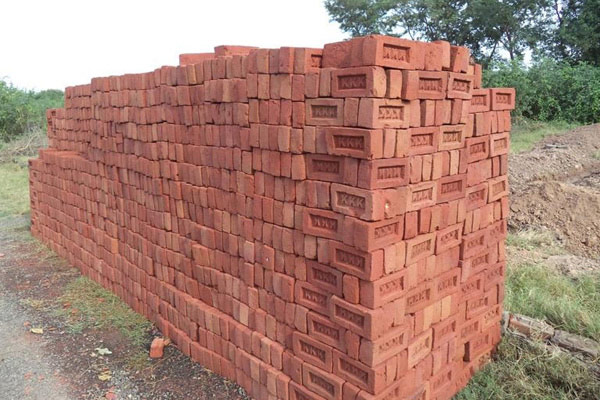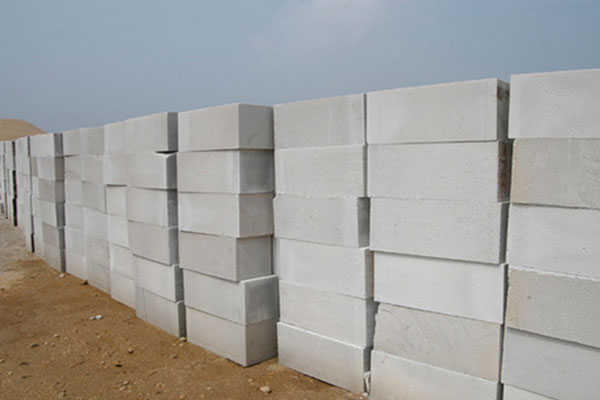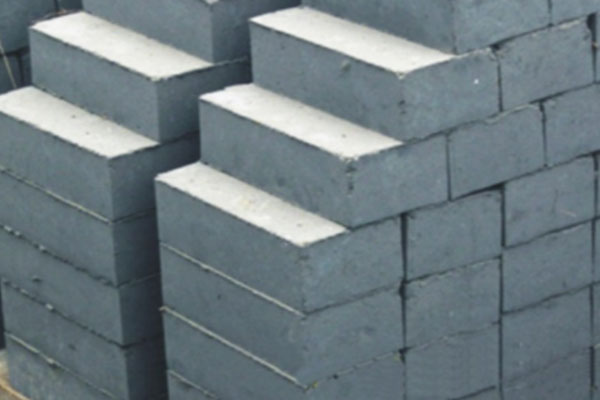
Looking for a smarter, more uniform alternative to traditional red clay bricks? Buildify supplies high-quality fly ash bricks in bulk across Gurugram, Delhi, Faridabad, and the entire NCR region at competitive prices with reliable, on-time delivery.
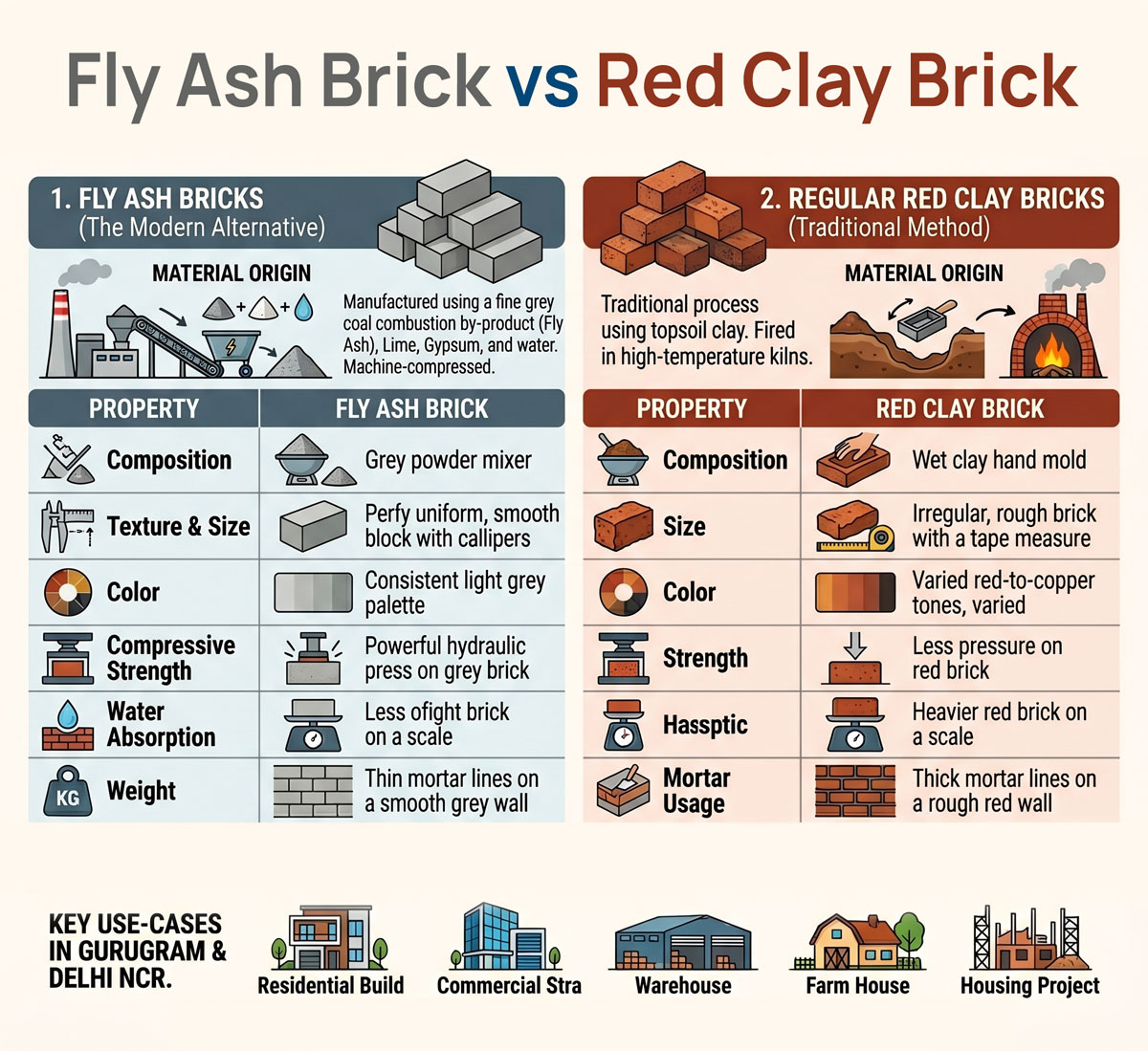
How are Fly Ash Bricks made?
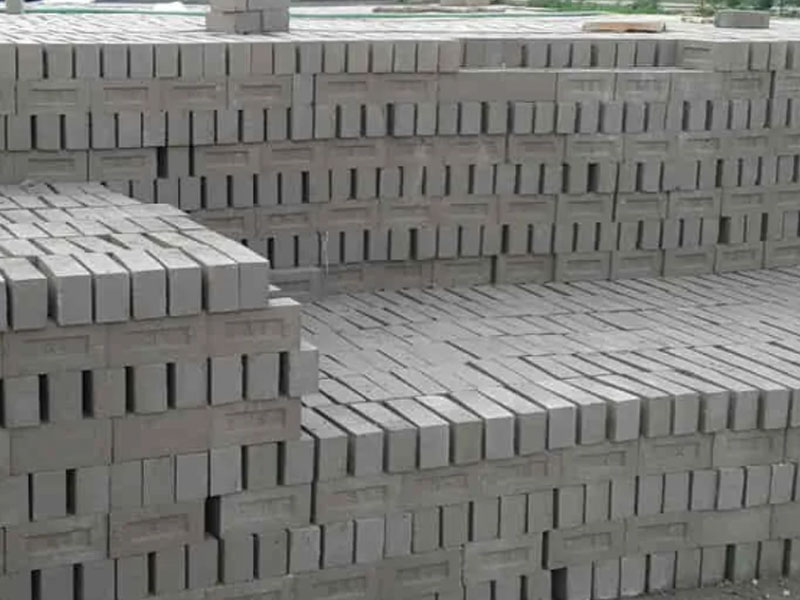
Step 1: Raw material mixing
Fly ash (60–70%), Lime, Gypsum and water are mixed together in precise proportions to form a uniform paste.
Step 2: Machine pressing
The mix is fed into hydraulic or vibro-pressing machines that compress it into a standard brick shape under high pressure, giving uniform size and density.
Step 3: Curing
Unlike red bricks that need a kiln, fly ash bricks are cured with water for 21–28 days and completely naturally sun dried process. This is what gives them their strength, no burning required.
Step 4: Quality check & dispatch
Bricks are tested for compressive strength and size uniformity before dispatch. Only passing bricks are loaded and delivered to your site.
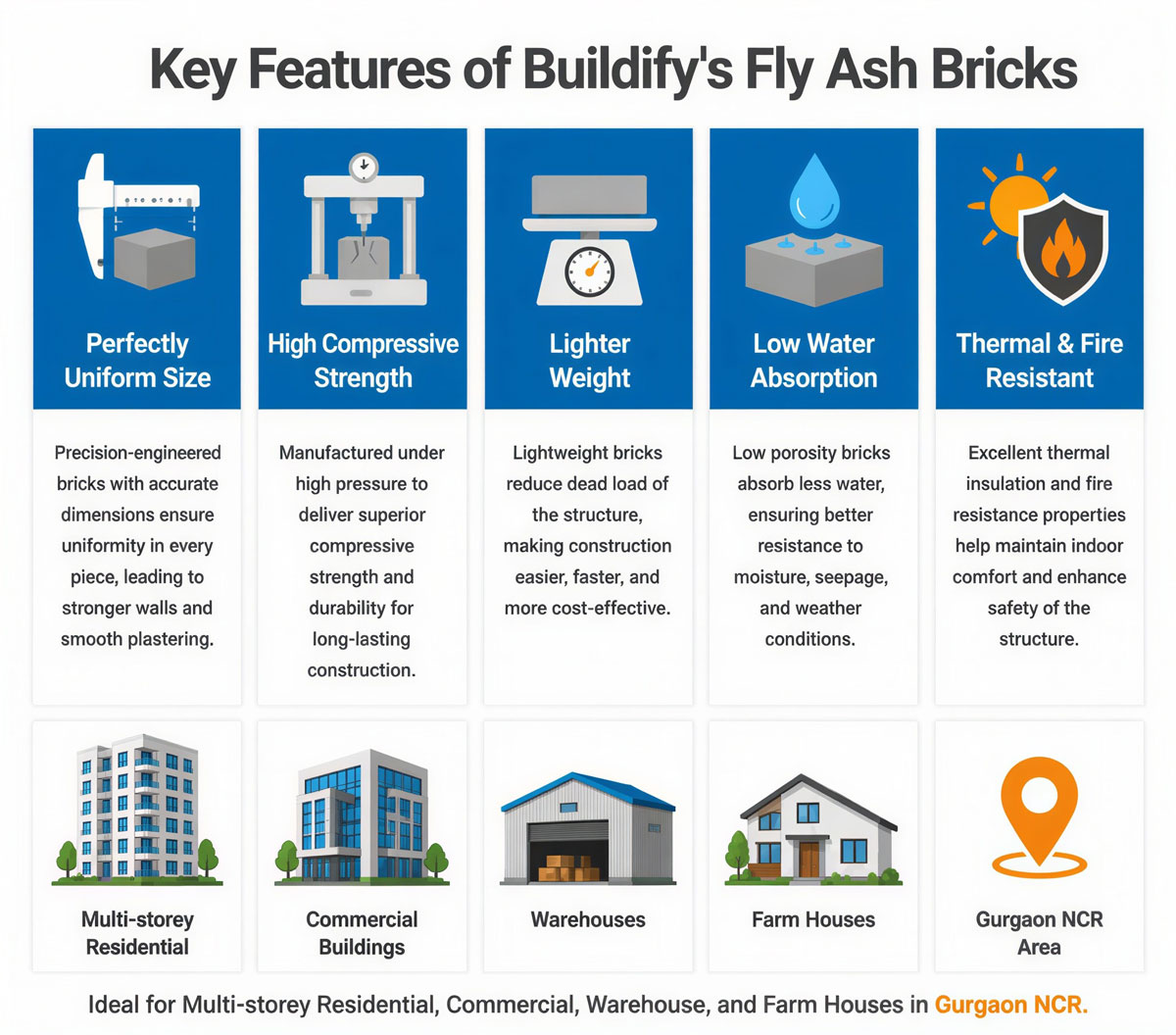
Which is better Red Bricks or Fly Ash Bricks?
This is the most common question buyers ask. Here's an honest, side-by-side comparison to help you decide:
| Parameter | Fly Ash Bricks | Red Clay Bricks |
|---|---|---|
| Size uniformity | Excellent, machine made, consistent | Variable, handmade, may differ slightly |
| Compressive strength | 7.5–10 N/mm² (consistent) | Varies by grade: 3.5–10 N/mm² |
| Weight | Lighter, lower dead load on structure | Heavier, adds more load to slabs |
| Water absorption | Less than 12% - very low | 15 - 22% depending on grade |
| Mortar consumption | Less, smooth surface, thin joints | More, rough surface needs more mortar |
| Plaster thickness needed | Thinner plaster coat required | Thicker plaster due to rough surface |
| Thermal insulation | Better, cooler rooms in summer | Good but slightly less effective |
| Eco-friendliness | Uses industrial waste, Lime and Gypsum and no soil mining | Uses natural clay, soil is consumed |
| Availability of grades | Single grade (standard) | Multiple grades for different budgets |
| Ideal use | Modern buildings, multi-storey, RCC frame | Good but slightly less effective |
Buildify's recommendation: For a modern RCC-framed house in Gurugram, fly ash bricks are an excellent choice for infill walls - they're lighter, stronger, and save on plastering cost. For boundary walls and plinth work, red bricks or a mix of both is more economical. Not sure? Call us on +91-9999253084 and we'll suggest the right brick for each part of your project.
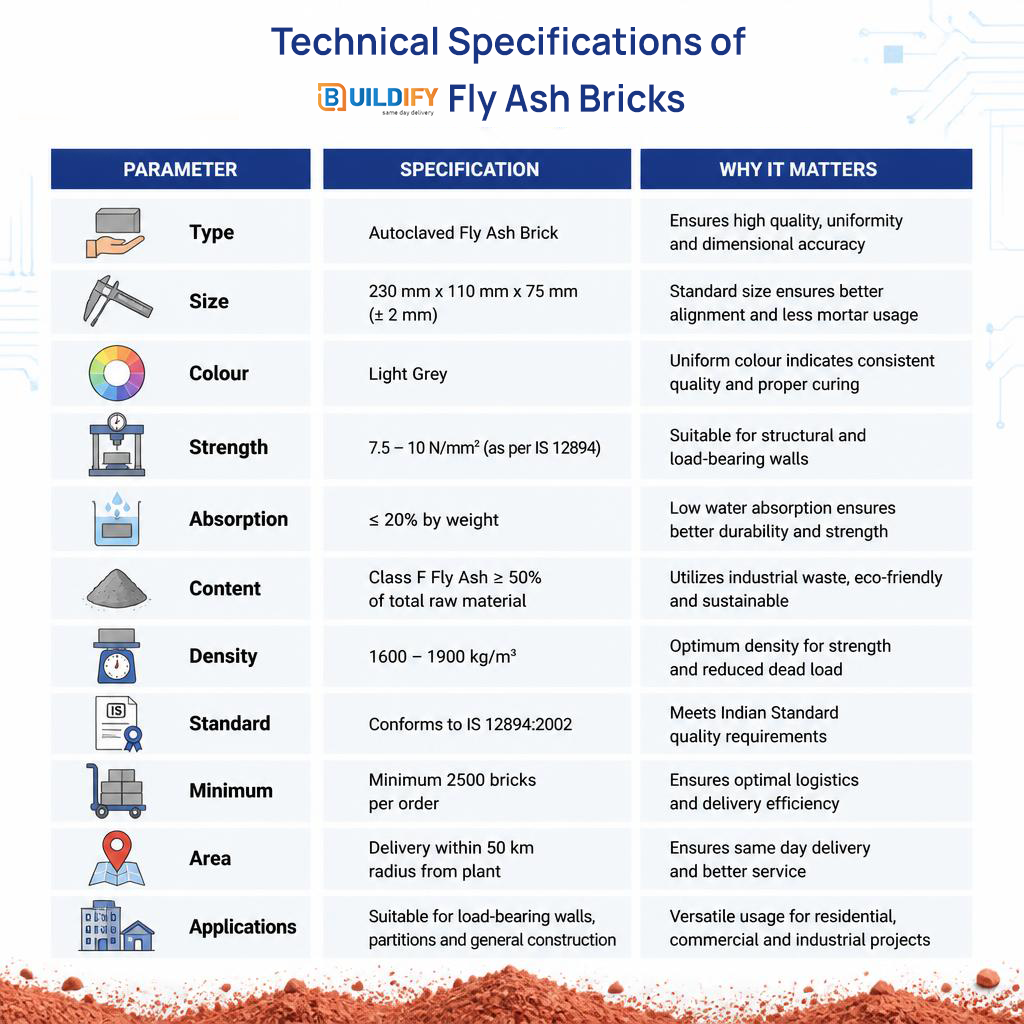
Common uses of Fly Ash Bricks in construction
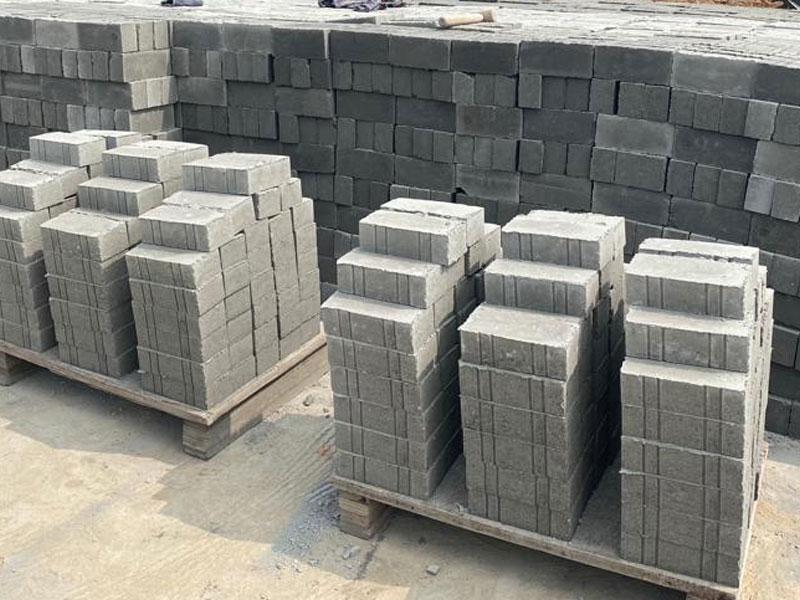
Infill walls (RCC frame)
Walls between columns & beams in framed structures.
Partition walls
Internal room dividers, lighter load on slab.
Load-bearing walls
Suitable for G+4 residential construction & Multi-storey buildings
Reduces dead load significantly on upper floors
Boundary walls
Clean, uniform finish requires less plastering
Commercial & industrial
Warehouses, offices, factories, and retail spaces
Common myths about Fly Ash Bricks, busted!
Many buyers hesitate about fly ash bricks based on things they've heard. Here's the truth:
| Myth | Fact |
|---|---|
| Fly ash bricks are weaker than red bricks | Quality fly ash bricks have a compressive strength of 7.5–10 N/mm², equal to or better than Class 1 red bricks. They are fully IS-certified for use in structural walls. |
| Fly ash bricks absorb too much water | Fly ash bricks absorb less than 12% water, lower than most grades of red bricks. This makes them better at resisting dampness and wall seepage over time. |
| Fly ash is toxic / unsafe for homes | Fly ash bricks are approved by the Bureau of Indian Standards (IS 12894) and are widely used in government and private construction across India. They pose no health risk once set in mortar. |
| They're more expensive than red bricks. | While the per-brick price goes around 30% less than Red bricks, fly ash bricks save money overall, you need less mortar, less plaster, and fewer bricks per wall due to their uniform size and lighter weight. |